

Present Day St Sidwell’s

Present Day and Today.
The Exeter Blitz aka The Baedeker Blitz Exeter suffered several bombing raids during the early years of WWII but it was the so called Baedeker Blitz of 1942 that caused the most devastation. The German Baedeker travel guide of the time listed Exeter as ‘the jewel of the south west’ and the city was one of several cultural and historic targets identified by Hitler following the Allies’ devastating raids on similar heritage-rich German cities, such as Lubeck. In the early hours of 4 May, Sidwell Street, a large area to the south and the city centre sustained huge damage during
Read More
Trams, buses and cars In 1905, electric trams were introduced to Sidwell Street as part of a city-wide network. They ran until August 1931, when the city authorities decided to make buses the only local transport. The advent of the motor car resulted in a lot of business for Sidwell Street with many garages opening up along its length between the 1920’s and World War II. Pubs and entertainment The Odeon Cinema, which opened on Sidwell Street in 1937, is the oldest survivor in Exeter from that golden age of movies. It was also used for concerts and had a
Read More
Rebuilding the Parish St Sidwell’s was gradually rebuilt after the Civil War and improvements were made for the life of its parishioners. In 1673 the Dean and Chapter paid for Sidwell Street to be paved from the East Gate to St Anne’s chapel and in the 1670s a workhouse was built in St Sidwell’s parish. By the mid 18th Century houses had been rebuilt along Sidwell Street from the East Gate all the way up to, and slightly beyond, St Anne’s chapel. A one-room schoolhouse was built in the churchyard, some almshouses were established near the church. The Wool Industry
Read More
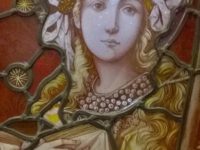
Saxon Christian girl beheaded by a scythesman and buried at St Sidwells The legend goes that Sidwella was a Saxon Christian girl living in Exeter in the 8th century. Her father was a nobleman named Benna who was very rich and had one son and four daughters. The family lived in the walled city of Exeter and Sidwella regularly left the city to bring food to the villagers working the fields at St Sidwells (then farmland). She was reputedly beautiful and virtuous. Her stepmother was jealous of her and wanted her killed, and paid a reaper to do the deed.
Read More
Following the Roman invasion of Britain in AD 43, the Second Legion Augusta built a fortress here in about AD 55. The Romans surfaced the earlier trackway with compacted gravel and it became one of the main Roman routes into the city, especially for travellers coming from the North East along the Fosse Way, the Roman road which linked Lincoln to Exeter. Shops and businesses catering to the needs of the travellers and the 6,000 resident Roman soldiers would have sprung up along the street. There would have been mills, markets, warehouses, meeting houses, brothels, metal-working and wood-working. Spring water
Read More
Norman Conquest Exeter grew in size and prosperity during the 10th Century and by AD 1000 it was the sixth richest city in the country. Much of this wealth would have come from trade in tin which was mined in the South West. Agriculture and wool were also becoming important to the livelihood of the inhabitants; tin was also being mined in south Devon and Cornwall. It was a time of migrants, of battles and conquests, and of mixing of ethnic groups. Exeter and St Sidwell’s were at the forefront of this churning of peoples. After the Norman invasion, King
Read More
In 1969 Meg Compton was a student at Bideford Art College and was asked by a tutor to be the face of St Sidwella for a new commission on Sidwell Street, Exeter. We were really pleased to meet Meg and she was happy for us to film her talking about her experience. Here it is, filmed with a mobile phone, on the spot, unedited.
Read More
The suburbe that lyith without the est gate of Excester is the biggest of al the suburbes of the towne, and berith the name of S. Sithewelle, where she was buried, and a chirch dedicate ther to her name. John Leyland (c.1542) A Strong Identity St Sidwell’s strong sense of its own identity as a distinct area outside the city walls can be traced back to at least the 11th Century when the Exeter bishop Leofric recovered estates which had been lost to the minster, including the land of St Sidwell’s. For centuries church and city argued about who governed
Read More
The parish was devastated in the English Civil War (1642 – 1646) when the Royalist defenders of Exeter cleared vast areas outside the city walls in preparation for a siege. They levelled Sidwell Street to the ground, leaving St Sidwell’s church alone in a sea of rubble in the area between the East Gate and St Anne’s chapel. The Parliamentarians destroyed the guildhall in St Sidwell’s, during their own bout of devastation in 1643. During the Civil War local legend has it that George Cheeke saved the bells of Allhallows church on Goldsmith Street from being smelted down for cannon
Read More