

Herbert Read
Read.
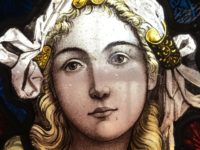
St Sidwell’s has two statues by world renowned sculptor Harry Hems. They were given to the church by Hems in 1888 to sit either side of the chancel arch. One depicts St Sidwella, Exeter’s patron saint, whilst the other is of St Boniface, another Devon saint. They were restored following a fundraising campaign in 2017 and are now on display in the community centre chapel.
Read More
Thomasine Shorte First person in the SW to be executed for witchcraft Thomasine (or Tamsin) Short was the wife of Robert Short, of St Sidwells, and lived somewhere outside the East Gate. She was clearly a mature woman by the time that she was first accused of witchcraft in the 1580s, because she had come before the city magistrates on several other occasions during the 1560s and 1570s, when she had been accused of ‘scolding’ and other crimes. It was later alleged that, in September 1580, Thomasine Short cursed the family of Richard Hewe, of Exe Island, weaver. Over the
Read More
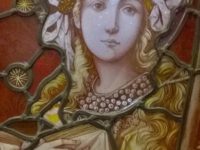
Saxon Christian girl beheaded by a scythesman and buried at St Sidwells The legend goes that Sidwella was a Saxon Christian girl living in Exeter in the 8th century. Her father was a nobleman named Benna who was very rich and had one son and four daughters. The family lived in the walled city of Exeter and Sidwella regularly left the city to bring food to the villagers working the fields at St Sidwells (then farmland). She was reputedly beautiful and virtuous. Her stepmother was jealous of her and wanted her killed, and paid a reaper to do the deed.
Read More
Sabine Baring-Gould was born in the parish of St Sidwell, Exeter, on 28th January 1834 and was baptised at St Sidwell’s church. He was an Anglican priest, antiquarian, novelist and writer of hymns, the best-known being ‘Onward, Christian Soldiers’. He was a prolific writer, publishing books with varied and eclectic subject matter such as ‘The Book of Were-Wolves, being an account of a terrible superstition’. He is also well known locally for his collections of folk songs from Devon and Cornwall. Baring-Gould helped organise the first scientific archaeological excavations of hut-circles on Dartmoor and formed the Committee of the Devonshire
Read More
Harry Hems was a world-renowned architectural and ecclesiastical master sculptor and wood carver who ran his thriving business from a workshop on Longbrook Street and was a larger-than-life character in the parish of St Sidwell’s. Carver not Cutler Born in London in 1842, the son of an ironmonger and cutler, he began his working life as a cutler. It evidently wasn’t the career he had in mind so he served an apprenticeship to a wood-carver in Sheffield, before seeking inspiration in Italy. After his travels ended badly (he was arrested as a spy) he returned to England penniless and found
Read More
Blue plaque to remember Exeter hero Dr. Peter Hennis, who is buried in the graveyard of St. Sidwell’s Church, is commemorated in a blue plaque erected by Exeter Civic Society on the graveyard wall. He is described as ‘a much admired and revered physician and hero of the cholera outbreak of 1832.’ Peter Hennis was born in Youghal, County Cork, Ireland and studied at Trinity College Dublin, London, Paris and Edinburgh before arriving in Exeter in 1830. He gained a reputation for his kindness and hard work tending the city’s poorest people during the cholera outbreak two years later. He
Read More
The Cheekes were an important family in St Sidwell’s, involved in the brewing trade. During the Civil War local legend has it that George Cheeke saved the bells of Allhallows church on Goldsmith Street from being smelted down for cannon balls by the parliamentarians. He went by night into the city and removed them to St Sidwell’s church, where they have remained ever since. Other sources state that St Sidwell’s bells were bought from Allhallows church in 1767. The street almost opposite the church still commemorates the family as Cheeke Street and the Victorian church had a memorial for them
Read More
Arrival of the Anglo-Saxons After the Romans left, the city declined in importance and lay dormant for 300 years. Dumnonian Britons lived inside the city walls and farmed the surrounding land, especially the St Sidwell’s area where there was a scattering of dwellings. The Anglo-Saxons arrived towards the end of the 7th Century. They built the first St Sidwell’s church in the 8th Century and it became a pilgrimage site for St Sidwella throughout Anglo-Saxon and medieval times. A medieval catalogue of relics in the Cathedral archives records that King Æthelstan , who ruled the English 924–39, visited the city
Read More